When you search for something online, you probably expect more than a page that simply contains the right keywords. You want information that feels reliable, comes from someone who knows the subject, and helps answer your question.
That is where E-E-A-T comes in.
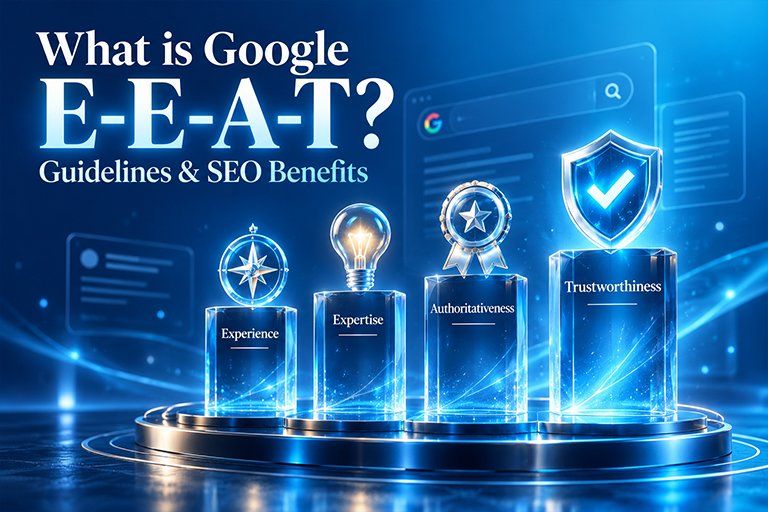
E-E-A-T stands for Experience, Expertise, Authoritativeness, and Trustworthiness. Google uses these concepts within its Search Quality Rater Guidelines to help assess the quality of search results. They are especially important when content could affect a person’s health, finances, safety, or other important decisions.
It is not a single ranking factor with a score that Google assigns to every website. Instead, it provides a useful framework for understanding what makes online content helpful, reliable, and worthy of trust.
What Does E-E-A-T Mean in SEO?
Each letter represents a different quality that can strengthen the credibility of your content.
- Experience looks at whether the creator has firsthand experience with the topic.
- Expertise considers the knowledge or skill demonstrated by the content creator.
- Authoritativeness relates to the reputation of the creator, website, or organization within its field.
- Trustworthiness focuses on whether the website and its content are accurate, transparent, and dependable.
These qualities can overlap. A financial article, for example, may benefit from an experienced writer, accurate information, qualified review, reputable sources, and a website that clearly identifies who is responsible for the content.
The Four Parts of E-E-A-T
1. Experience
Experience is about firsthand involvement.
Imagine you’re reading a review of a new smartphone. A person who has actually used the phone for several weeks can provide observations about its battery life, camera, usability, and everyday performance that you may not get from someone who only reads the manufacturer’s specifications. This is one reason E-E-A-T places value on content that reflects genuine experience.
For businesses, this could mean sharing original case studies, customer experiences, project results, product demonstrations, or practical insights from people who have actually worked with the subject.
2. Expertise
Expertise is about having the knowledge and skills needed to provide useful information. The level of expertise needed depends on the topic. A professional accountant writing about tax requirements brings a different type of expertise than a hobbyist reviewing a new cooking appliance.
For topics involving health, finance, legal matters, or safety, qualifications and professional knowledge become particularly important. Showing who created or reviewed your content can help readers understand why they should consider that information credible.
3. Authoritativeness
Being knowledgeable is one thing. Being recognized as a reliable source within your field is another.
Authoritativeness can develop when other reputable websites reference your work, industry professionals recognize your expertise, and your website consistently provides useful information about a particular subject. A business can strengthen this aspect of E-E-A-T by publishing original research, contributing expert commentary, earning relevant mentions, and building a strong reputation within its industry.
4. Trustworthiness
Trust is at the center of the entire concept.
Visitors should be able to understand who operates the website, who created its content, how they can contact the business, and what happens to information they submit.
Website security matters, too. Clear privacy policies, accurate business information, secure connections, transparent claims, and straightforward contact details can all contribute to a more trustworthy experience. If your website asks users to provide personal or financial information, trust becomes even more important.
How Does E-E-A-T Benefit SEO?
There is no button you can switch on to instantly improve your E-E-A-T. Instead, the goal is to create a website that consistently demonstrates useful qualities that benefit both users and search visibility.
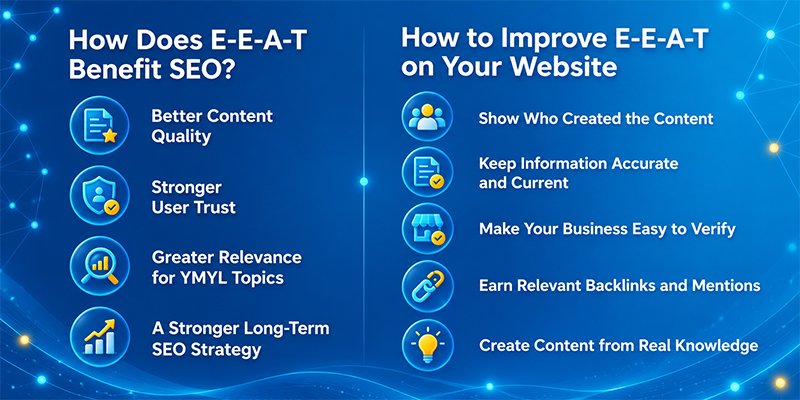
Better Content Quality
Following E-E-A-T principles encourage businesses to move beyond generic content. Instead of rewriting information that already exists, you can add original insights, practical examples, expert opinions, and information that genuinely helps your audience.
Stronger User Trust
People are more likely to engage with a business when they can see who is behind its content and understand why that business is qualified to speak about the subject. That trust can influence more than search behavior. It can also affect whether someone contacts your business, makes a purchase, or returns to your website.
Greater Relevance for YMYL Topics
YMYL stands for “Your Money or Your Life.” These topics can have a meaningful impact on a person’s health, financial stability, safety, or well-being. For these subjects, demonstrating strong E-E-A-T is particularly important because users need information, they can reasonably rely on.
A Stronger Long-Term SEO Strategy
Search continues to change. Creating content solely around keywords or trying to take shortcuts may not provide lasting results. Building useful content around real experience, knowledge, authority, and trust gives your website a stronger foundation as search continues to evolve.
How to Improve E-E-A-T on Your Website
Improving E-E-A-T is not about adding a few trust signals to a website and considering the work finished. It should be part of how you create, review, and present your content.
Show Who Created the Content
Add clear author bylines to your articles. Where relevant, include the author’s qualifications, professional background, or experience with the subject. For expert-led topics, having qualified professionals review content can provide additional context about its credibility.
Keep Information Accurate and Current
Even well-written content loses value when the information becomes outdated. Review important pages regularly. Update statistics, facts, links, product details, regulations, and recommendations when they change. If a page has been significantly updated, make that clear to readers.
Make Your Business Easy to Verify
Visitors should not have to search through your website to figure out who you are. Include a clear About page, contact information, business details, and other relevant information that helps visitors understand the organization behind the website.
Earn Relevant Backlinks and Mentions
Links from reputable websites can help establish your site’s reputation, but quality matters more than simply collecting a large number of backlinks. Original research, useful resources, expert contributions, and genuinely valuable content can give other websites a reason to reference your work.
Create Content from Real Knowledge
One of the simplest ways to strengthen E-E-A-T is to stop creating content just because a keyword has search volume.
Talk about what your business actually knows. Share lessons from your work, answer common customer questions, explain complicated subjects clearly, and provide information your audience can use. That makes the content more useful in the first place.
Build a More Trustworthy SEO Strategy with InfinityHub
Strong SEO is not only about getting a page into search results. It is about giving people a reason to trust what they find when they get there.
E-E-A-T provides a useful way to evaluate trust. By demonstrating real experience, showing relevant expertise, building authority, and making your website trustworthy, your business can create content that serves both users and a long-term SEO strategy.
InfinityHub helps businesses develop SEO and content strategies focused on useful, credible, and search-friendly websites. From content planning and optimization to broader SEO strategies, our approach focuses on building sustainable visibility rather than relying on shortcuts.
Get Free Quote
Facebook
Twitter
LinkedIn
WhatsApp