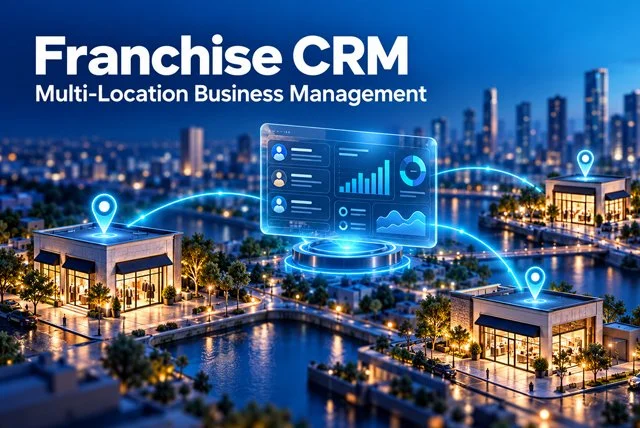
Growing a business across multiple locations sounds exciting. More branches mean more customers, more opportunities, and a larger presence in the market. But growth also creates a practical challenge: how do you keep every location connected without making the central team responsible for every small task?
This becomes even more important for franchise businesses. Each location may have its own team, customers, sales activity, and local requirements, while the brand still needs a consistent way to manage information and monitor performance.
A franchise CRM helps bring these two sides together. It gives the central team a broader view of the franchise network while allowing individual locations to manage their own customer relationships and sales activities.
Why Managing Multiple Locations Gets Complicated
One location is relatively easy to keep track of. Customer details, enquiries, sales updates, and follow-ups usually stay within the same team.
Add another location, and information starts moving between teams. Add five more, and keeping everything updated becomes a different challenge.
A franchise network can quickly end up with customer details in spreadsheets, leads shared through messages, sales updates sent over email, and branch reports maintained separately. None of these methods necessarily fail on their own. The problem is that they do not provide one clear view of the business.
A franchise CRM brings these activities together, so information from different locations can be managed within a common system.
One Brand, Many Locations
Franchise businesses have a structure that ordinary single-location businesses do not. The corporate team manages the larger brand and its direction. Franchisees handle customers and sales in their respective locations. Both sides need access to information, but they do not need access to everything.
This is where a franchise CRM becomes useful. The corporate team can monitor activities across branches, while franchise users can focus on their own customers and leads. Access can also be organized according to locations, teams, or user roles.
Instead of choosing between complete central control and complete independence, businesses can create a more practical balance.
Getting Every Lead to the Right Franchise
Lead distribution becomes increasingly important as a franchise network grows.
Consider a customer who submits an enquiry from a particular city. If the business has multiple franchise locations nearby, the enquiry needs to reach the appropriate team quickly. Sending it manually from one person to another creates unnecessary delays and leaves room for mistakes.
A franchise CRM can help assign leads based on factors such as location, territory, PIN code, branch, or predefined business rules.
The right franchise gets the enquiry. The local team can then take over the conversation, schedule follow-ups, and update the lead status. At the same time, the central team can retain visibility into what happens after the enquiry is received.
Keeping the Customer Experience Consistent
Customers may interact with different franchise locations, but they still see the same brand. That makes consistency important.
One branch may use an updated campaign while another continues using an older offer. One team may follow a particular communication style while another takes a completely different approach. Over time, these differences can affect how customers perceive the brand.
A franchise CRM can give central teams a common place to manage approved templates, marketing material, customer communication resources, and other brand assets.
Franchisees can use these resources when engaging with customers, while the corporate team has better control over the information being shared across locations.
Seeing What Is Happening Across the Network
Knowing how all branches are performing together can reveal much more.
A franchise CRM can bring location-level data into a shared reporting environment. Businesses can look at leads, customer activity, conversions, sales performance, and campaign responses across different locations.
This can help answer questions such as:
- Which locations are generating more enquiries?
- Where are leads taking longer to convert?
- Which campaigns are producing better responses?
- Are some territories performing differently from others?
- Which branches need additional attention?
The purpose is not simply to compare branches. It is to understand what the numbers are saying about the business as a whole.
Why Raseed Can Support Growing Franchise Networks
For a growing brand, managing customer relationships across multiple locations requires more than storing contact information. The system needs to connect customer activity, sales information, leads, and branch-level data in a way that both corporate teams and franchisees can use.
Raseed can support this connected approach by bringing customer and sales activities into a common platform. Franchise locations can manage their own customer interactions while the wider business gets greater visibility into activity across its network.
As the number of locations grows, having this information connected can make it easier to understand performance, manage enquiries, and maintain consistency across the brand.
Growth Is Not Just About More Locations
Opening a new franchise is only one part of expansion. The bigger challenge is making sure every new location becomes part of the same business rather than turning into another isolated operation.
That is where a franchise CRM can make a difference. It connects the people, customer information, leads, and business activity spread across different locations while giving each franchise the space to manage its own operations.
For businesses planning multi-location growth, the right CRM can provide the foundation needed to manage that expansion with greater clarity. Because when a business grows from one location to many, staying connected becomes just as important as getting bigger.
Popular Search
Get Free Quote
Facebook
Twitter
LinkedIn
WhatsApp