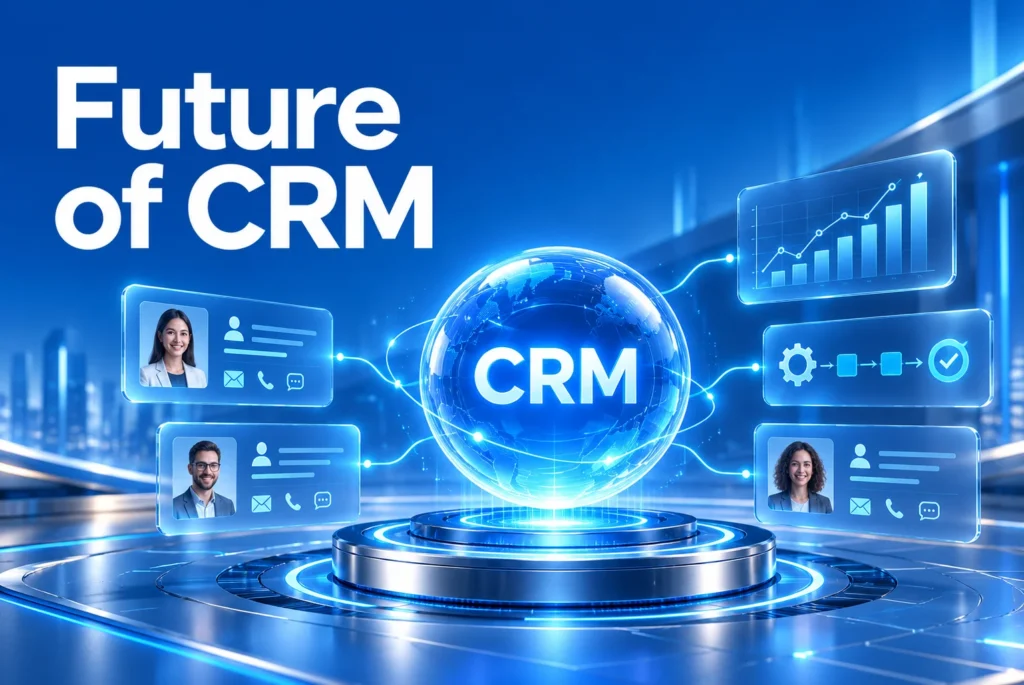
Customer relationship management has come a long way from maintaining contact lists and recording sales activities. Today, businesses expect their CRM systems to do more than store information. They want useful insights, timely recommendations, and less manual work.
This is where AI CRM is changing the way organizations manage customer relationships. By combining artificial intelligence (AI) with machine learning (ML), modern CRM platforms can analyze customer data, identify patterns, support decision-making, and automate selected tasks. In 2026, the focus is shifting from simply recording what happened to understanding what might happen next.
From Customer Records to Intelligent Workflows
Traditional CRM systems depend heavily on employees to enter information, update records, and track follow-ups. These activities are necessary, but they can take time away from customer conversations and sales opportunities.
AI introduces another layer of support. It can summarize interactions, suggest follow-up actions, identify patterns in sales data, and help employees prioritize their work. Some systems can also carry out specific tasks with limited human involvement.
The difference is significant. Instead of reviewing every record manually, a sales representative might receive a prioritized list of leads that deserve attention. Employees remain responsible for important decisions, while automation handles suitable routine activities.
Key AI CRM Trends Shaping 2026
Agentic AI and Task Automation
AI is moving beyond answering questions and generating content. Agentic AI systems can plan and carry out sequences of tasks within defined permissions and workflows.
For example, an AI agent might qualify an incoming lead, collect relevant information, and recommend the next action. Depending on its capabilities and permissions, it may also update records or initiate a follow-up workflow.
However, not every CRM offers fully autonomous agents. Human review remains important for sensitive decisions and customer-facing actions.
2. More Relevant Customer Experiences
Customers expect communication that reflects their interests and previous interactions. Generic messages often fail to address what they actually need.
AI CRM tools can use available customer data to help personalize emails, recommend relevant products, and tailor campaign content. Machine learning can identify patterns in customer preferences, helping businesses make their communication more relevant.
Personalization still depends on having accurate information and using it appropriately. More data does not automatically mean better engagement.
3. Predictive Insights for Sales and Retention
Historical sales records can reveal patterns that are difficult to spot manually. Machine learning models analyze these patterns to estimate which leads may convert, which customers could stop engaging, and which opportunities need attention.
These predictions help teams prioritize their efforts. A representative might focus on a promising lead, while a customer success team investigates signs of declining engagement.
Predictions are not guarantees. Their usefulness depends on data quality, the model used, and how well its results reflect actual business conditions.
4. Conversational and Voice-Based CRM
Updating CRM records can interrupt the flow of a busy working day. Conversational AI is making these interactions simpler.
Depending on the platform, employees may be able to ask questions about sales activities, summarize meetings, draft emails, or retrieve information using natural language. Some tools can also analyze recorded conversations and extract key points or action items.
This reduces repetitive administration and helps employees focus on the work that requires their judgment.
5. Connected Business Systems
Customer information rarely exists in one place. Sales, marketing, finance, and support teams often use different applications, each holding part of the picture.
Modern AI CRM strategies increasingly focus on connecting these systems so that insights are based on relevant information from across the business. Better integration can reduce information gaps and provide a clearer view of customer activity.
Data access and synchronization must be managed carefully. An AI system is only as useful as the information it can reliably access.
The Role of Machine Learning in AI CRM
AI provides capabilities such as content generation, reasoning, and automation. Machine learning enables systems to identify patterns in data and improve their predictions through training and evaluation.
In CRM, ML supports lead scoring, sales forecasting, customer segmentation, product recommendations, and churn prediction. For instance, a model can examine previous sales outcomes to identify characteristics associated with successful conversions.
As new information becomes available, models can be evaluated and updated to reflect changing customer behavior. This requires ongoing monitoring rather than assuming predictions will remain accurate indefinitely.
Data Quality, Privacy, and Responsible AI
Advanced AI cannot compensate for unreliable customer records. Duplicate contacts, outdated details, and incomplete sales histories can lead to misleading recommendations or inappropriate communication.
Businesses should establish clear data management practices before expanding AI across their CRM workflows. Regular data checks, consistent record updates, and appropriate system integrations provide a stronger foundation.
Privacy matters just as much. Organizations need to control access to customer information, understand how data is processed, and review automated decisions where necessary. Human oversight is especially important when AI influences customer eligibility, sensitive communications, or significant business decisions.
Popular AI CRM Platforms in 2026
Several established CRM providers now offer AI capabilities as part of their platforms. These include Salesforce Einstein and Agentforce, Microsoft Dynamics 365 Copilot, HubSpot Breeze AI, Zoho CRM Zia, and Freshsales Freddy AI.
Their features and availability vary. Businesses should compare capabilities against their workflows, integration requirements, data policies, and budget before choosing a platform.
Preparing Your Business for the Future of CRM
AI CRM is changing how businesses manage leads, understand customers, and organize everyday work. Yet adopting the latest technology is not a strategy on its own.
Start by identifying repetitive tasks, gaps in customer information, and decisions that could benefit from better insights. Then evaluate which AI capabilities address those needs and how their results will be measured.
For businesses using CRM HUB 360, lead management, marketing automation, sales tracking, and analytics provide a foundation for organizing customer-related activities. As AI capabilities evolve, businesses should evaluate relevant integrations and enhancements based on their actual availability and suitability.
The future of CRM is not simply about automating more tasks. It is about helping people make better decisions, respond to customers with greater understanding, and use business information more effectively.
Get Free Quote
Facebook
Twitter
LinkedIn
WhatsApp